

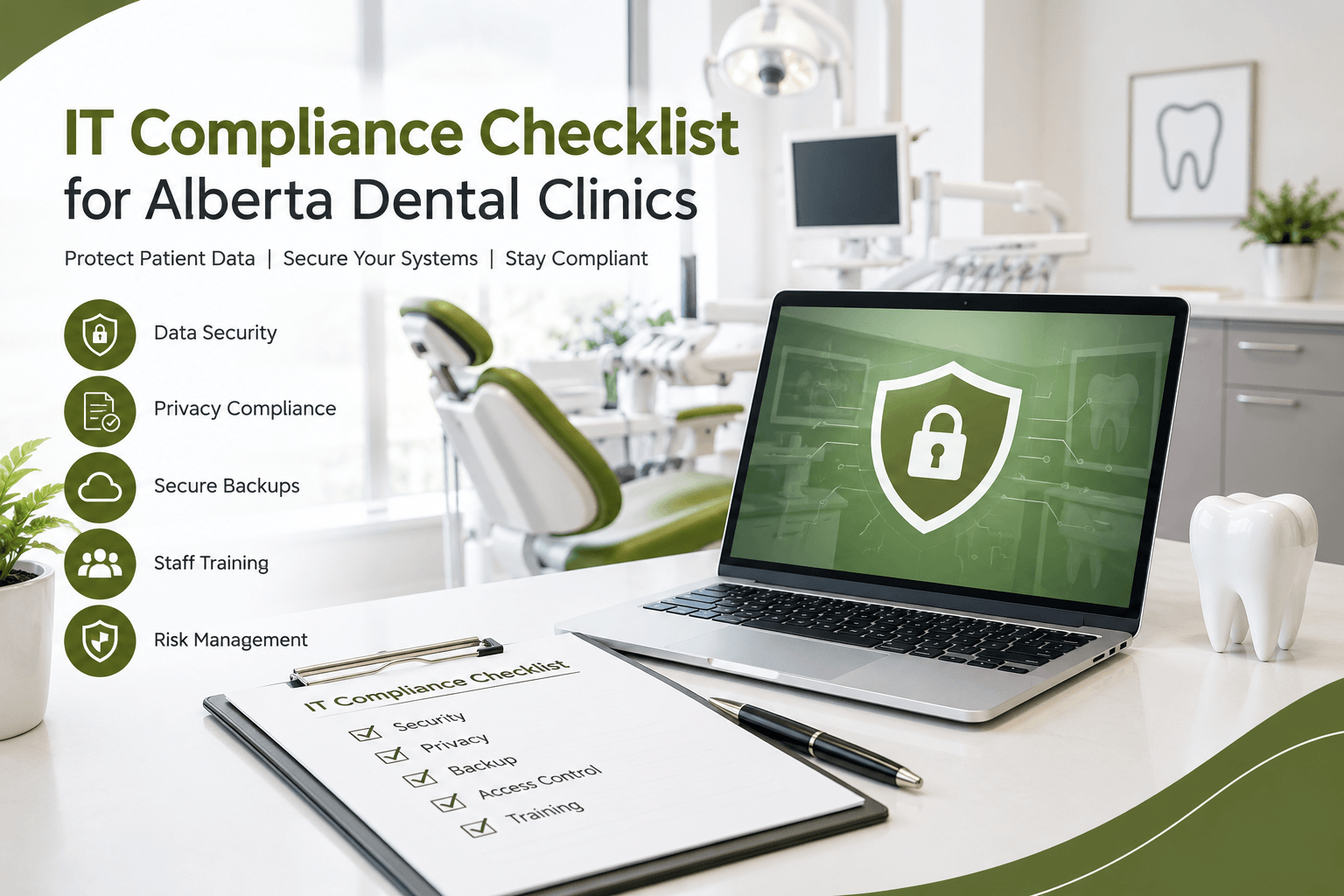

Dental clinics in Alberta manage highly sensitive patient information every day. From digital dental records and X-rays to billing details, appointment information, and email communications, this data must be protected against unauthorized access, loss, and cyber threats. Therefore, having a reliable IT compliance checklist for Alberta dental clinics is essential for protecting patients and maintaining a secure practice.
For dental offices, compliance is not only about having antivirus software installed. Instead, it involves privacy policies, secure systems, access controls, backups, employee training, and an effective plan for responding to incidents. With the right technology partner, such as MVP IT, dental practices can strengthen their IT environment while keeping security and compliance at the centre of daily operations.
1. Understand Alberta Privacy Requirements
First, dental clinics should understand which privacy requirements apply to their practice. Alberta’s Health Information Act (HIA) governs health information held by designated custodians, and Alberta identifies dentists among the health professionals covered by its health-information framework.
Additionally, Alberta’s Personal Information Protection Act (PIPA) applies to private-sector organizations and requires businesses to take reasonable measures to protect personal information.
Consequently, dental clinics should review their privacy responsibilities alongside their technology policies rather than treating IT security as a separate concern.
2. Secure Patient Records and Devices
Next, every device that can access patient information should be properly secured. This includes desktop computers, laptops, tablets, servers, and mobile devices.
A dental IT compliance checklist should include:
- Strong, unique passwords
- Multi-factor authentication where appropriate
- Automatic screen locking
- Encryption for sensitive data
- Up-to-date operating systems and software
- Endpoint protection and antivirus tools
- Restricted administrator access
Furthermore, access should be based on job responsibilities. For example, reception staff may need access to scheduling and billing systems, while clinical staff may require access to patient records. Limiting unnecessary access reduces the potential impact of compromised credentials.
3. Maintain Reliable Backups
Cyberattacks, hardware failures, accidental deletion, and other technical problems can disrupt a dental practice. Therefore, reliable backups are a critical part of IT compliance and business continuity.
Dental clinics should maintain secure, regularly tested backups of important systems and data. Moreover, backups should be protected from unauthorized access and, where appropriate, isolated from the primary network.
A backup that has never been tested may not provide dependable protection when a serious incident occurs. As a result, clinics should periodically verify that important files and systems can actually be restored.
MVP IT can help dental practices establish backup and recovery strategies designed around their operational requirements.
4. Control User Access
Another important part of compliance is controlling who can access patient information. Employee accounts should be created according to specific responsibilities, while former employees and unnecessary accounts should be removed promptly.
Additionally, administrative privileges should be limited to authorized personnel. Regular reviews of user accounts can identify inactive accounts, excessive permissions, or other security weaknesses before they become larger problems.
5. Protect Email and Cloud Services
Email is a common communication tool in dental offices; however, it can also create security risks. Phishing emails, malicious attachments, compromised passwords, and accidental data sharing can expose sensitive information.
For this reason, clinics should use strong email security, multi-factor authentication, spam and phishing protection, and appropriate access policies. Similarly, cloud applications should be reviewed to determine how patient and business information is stored, accessed, and shared.
When third-party providers are involved, clinics should also understand their privacy and security responsibilities. Alberta guidance specifically addresses situations where organizations use service providers outside Canada to collect or transfer personal information.
6. Create a Cybersecurity and Breach Response Plan
Even well-protected dental clinics cannot assume that an incident will never happen. Therefore, every practice should have a documented incident response plan.
The plan should explain who will respond, how affected systems will be contained, how evidence will be preserved, and when appropriate notifications should be made. Under the HIA, custodians have mandatory breach-notification obligations when a loss, unauthorized access, or disclosure creates a risk of harm.
Similarly, PIPA includes privacy breach requirements for organizations when a breach creates a real risk of significant harm.
7. Train Your Dental Team
Technology alone cannot prevent every security incident. Employees also play a major role in protecting patient information.
Therefore, dental clinics should provide regular training covering phishing, password security, suspicious emails, device security, appropriate data handling, and privacy procedures. Additionally, staff should know exactly who to contact when they notice a potential security incident.
Regular training helps turn cybersecurity from an IT responsibility into a practice-wide responsibility.
8. Review Your Compliance Regularly
Finally, IT compliance should be reviewed regularly rather than treated as a one-time project. Software changes, new employees, cloud services, connected dental equipment, and emerging cyber threats can all change a clinic’s risk profile.
A periodic IT assessment can identify outdated systems, weak security controls, backup issues, and unnecessary access privileges. MVP IT can help Alberta dental clinics review their technology environment and develop practical improvements that support security, reliability, and compliance.
Frequently Asked Questions
What IT compliance requirements apply to Alberta dental clinics?
Depending on the clinic and its activities, Alberta privacy requirements can include the Health Information Act and Personal Information Protection Act. Dental practices should assess their specific legal and professional obligations.
How can a dental clinic protect patient records?
Clinics should use strong access controls, secure devices, encryption, multi-factor authentication, reliable backups, endpoint protection, and employee security training.
Are backups part of dental IT compliance?
Backups are an important component of a secure IT environment. However, clinics should also regularly test restoration and protect backup systems from unauthorized access.
What should a dental clinic do after a data breach?
The clinic should follow its documented incident response process, contain the incident, assess the information involved, and determine whether applicable notification requirements have been triggered. Legal and privacy obligations can vary depending on the circumstances.
Can an IT company help with dental clinic compliance?
Yes. An experienced dental IT provider can help implement security controls, backups, access management, monitoring, employee training, and incident-response procedures. However, clinics should also obtain professional privacy or legal advice where required.
Protect Your Dental Practice with MVP IT
A secure dental practice needs more than dependable computers. It needs an IT environment designed to protect patient information, support staff, reduce downtime, and respond effectively to cybersecurity risks.
MVP IT provides IT support and cybersecurity solutions for businesses in Alberta, helping dental clinics build a more secure and reliable technology environment. Whether you need stronger backups, improved cybersecurity, network support, or an IT compliance review, our team can help.
Contact MVP IT at (587) 585-6871 or visit us at 3850 19 St NE Bay 5, Calgary, AB T2E 6V2, or 14065 Victoria Trail NW #211, Edmonton, AB T5Y 2B6, to discuss your dental IT requirements and take the next step toward a safer, more resilient practice.